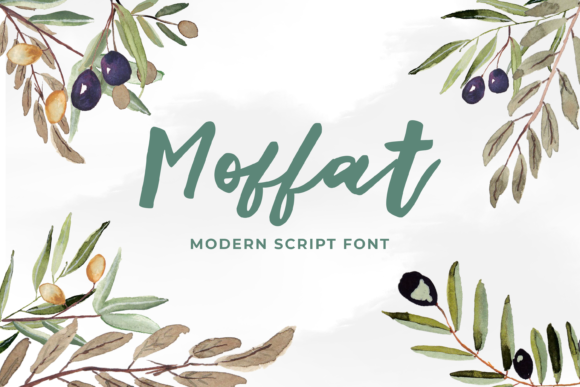
Moffat Font: A Modern Paint-Brushed Script for Handmade Creators
If you’ve ever spent hours tweaking letter spacing on a wedding welcome sign—only to realize the script feels too stiff, too generic, or just *off*—you’ll understand why I reached for Moffat the moment I saw it. This isn’t just another cursive font. It’s a modern paint-brushed script with organic flow, subtle texture, and quiet confidence—designed not for scrolling, but for holding: in hands, on shelves, tucked into gift boxes, or pressed onto linen napkins.
Moffat lives in that sweet spot between elegance and approachability. Its strokes mimic the natural variation of a brush—slightly tapered, gently irregular, never mechanical. There’s warmth in its curves and intention in its rhythm. Unlike overly ornate scripts that vanish at small sizes or choke cutting machines, Moffat balances decorative charm with real-world legibility. That makes it ideal for physical products where clarity and character must coexist: think candle labels with delicate scent names, boutique clothing tags with founder signatures, or farmhouse-style wall signs meant to hang for years—not just look pretty in a mockup.
I use Moffat across my entire product line—from printable planner stickers to heat-transfer vinyl designs for tote bags—and it consistently lifts the perceived quality of what I make. Customers notice it. Not because it shouts, but because it feels *considered*. A thank-you card in Moffat reads like a personal note, even when printed in batches. A logo using Moffat as the wordmark (paired with a clean sans serif for the tagline) tells clients your brand values craftsmanship over flash. That emotional resonance? It’s not accidental. It’s built into the weight distribution, the x-height, the way the lowercase “g” curls just so.
For crafters using Cricut Design Space or Silhouette Studio, Moffat cuts cleanly at sizes as small as 8pt on sticker paper—especially when you avoid overloading swashes on tiny labels. I reserve its most expressive alternates and ligatures for hero pieces: wedding invitation suites, large-format wall art, or seasonal greeting cards where space allows the font to breathe. On product packaging—like mini soap boxes or tea tins—I often use Moffat for the product name only, then switch to a crisp sans serif (think Montserrat or Inter) for ingredients or care instructions. That pairing creates hierarchy without sacrificing personality.
It shines brightest in short-form applications: names, titles, quotes, and phrases under 5–7 words. I wouldn’t set a full paragraph in Moffat—but I *would* use it for the headline on a printable quote poster, the “Est. 2023” stamp on a small business label, or the “Hand-Poured” line on a soy candle jar. Its readability holds up beautifully on matte-finish kraft paper and glossy vinyl alike, and it previews accurately in Canva, Adobe Illustrator, and even basic PNG mockups—no surprise rendering glitches mid-print run.
One thing I appreciate: Moffat comes with thoughtful extras—standard and discretionary ligatures, stylistic alternates for letters like “a,” “f,” and “t,” plus uppercase swashes that add polish without clutter. These aren’t gimmicks; they’re tools. The alternate “y” gives my holiday collection tags a more vintage feel, while the connected “th” ligature keeps my wedding suite invitations feeling fluid and intentional. All files are delivered in OTF and TTF formats—so whether you're exporting SVGs for cutting machines or embedding fonts in digital templates, you’re covered. And yes—it supports extended Latin characters, which matters if you sell internationally or create bilingual baby shower invites.
Practically speaking, I’ve used Moffat for:
- Candle & soap labels — especially for botanical or artisanal brands where handcrafted authenticity matters
- Wedding welcome boards & seating charts — its brush texture softens acrylic or wood signage beautifully
- Digital printables — planner headers, habit trackers with motivational quotes, and printable wall art sold as instant downloads
- SVG cut files — layered designs for t-shirts, mugs, and reusable shopping bags (I always test-cut the lowercase “s” first—it’s the truest test of a script’s cut-friendliness)
- Seasonal product packaging — “Cozy Season,” “Summer Solstice,” or “Gather & Give” stamped on kraft gift tags or holiday tin labels
Font pairing is where Moffat really sings. I almost always pair it with a neutral, highly legible sans serif—something with open counters and friendly proportions, like Poppins, Lato, or even the free Google Font Manrope. That combo works for everything: a boutique’s Instagram story (Moffat for the offer, sans for the fine print), a printable recipe card (Moffat for the dish name, sans for ingredients), or a client’s logo (Moffat for the business name, sans for the slogan). For contrast with serif fonts, I lean toward low-contrast serifs like Merriweather or Playfair Display—never high-contrast Didones, which compete rather than complement.
A quick but essential note on licensing: Moffat is a commercial font from Script Amp, and its license explicitly covers use in physical products, digital downloads, templates, SVG files, and merchandise you sell—no extra fees or attribution required. That means you can embed it in Canva templates, include it in your Procreate brush kits, or use it to design Cricut-ready files for Etsy—without second-guessing. Just keep your original font files secure, and never resell or redistribute the font itself. That clarity alone saves me hours of legal review before each product launch.
At the end of the day, Moffat isn’t about trend-chasing. It’s about finding a voice that feels like yours—refined but human, elegant but grounded, distinctive but never distracting. Whether you're printing 10 custom napkins for a micro-wedding or scaling up to 500 holiday gift tags for your Etsy shop, Moffat delivers consistency, charm, and quiet professionalism. It doesn’t try to do everything. It does one thing beautifully—and that’s exactly what handmade creators need.